
Out of the box, the Creality Ender 3 V2 is a budget-friendly 3D printer designed for entry-level PLA and PETG printing. However, its stock limitations—such as PTFE-lined hotends that degrade above 230°C, Bowden tube retractions causing stringing, noisy stepper drivers, and finicky SD card bootloaders—prevent makers from printing high-performance engineering materials like ASA, ABS, Polycarbonate, and flexible TPU.
By replacing the stock electronics with a BigTreeTech SKR Mini E3 V3.0 (STM32G0B1RE 32-bit MCU), upgrading to a Micro Swiss Dual-Gear Direct Drive Extruder, installing a high-precision PT1000 RTD temperature sensor with a 70W heater cartridge, and establishing a 5-wire SWD recovery bridge, the humble Ender 3 V2 transforms into a high-precision industrial prototyping engine capable of competing with $1,200+ Voron 2.4 and Bambu Lab 3D printers.
Download BTT SKR Firmware, SWD Scripts & Schematics
Access pre-configured Marlin / Klipper firmwares, OpenOCD 5-wire SWD scripts, and ESP32 wireless flasher source code on GitHub:

Shop BTT SKR Deal →

Shop Raspberry Pi 4 Deal →

Shop WEMOS Deal →
📸 1. Hardware Architecture & Electro-Mechanical Breakdown
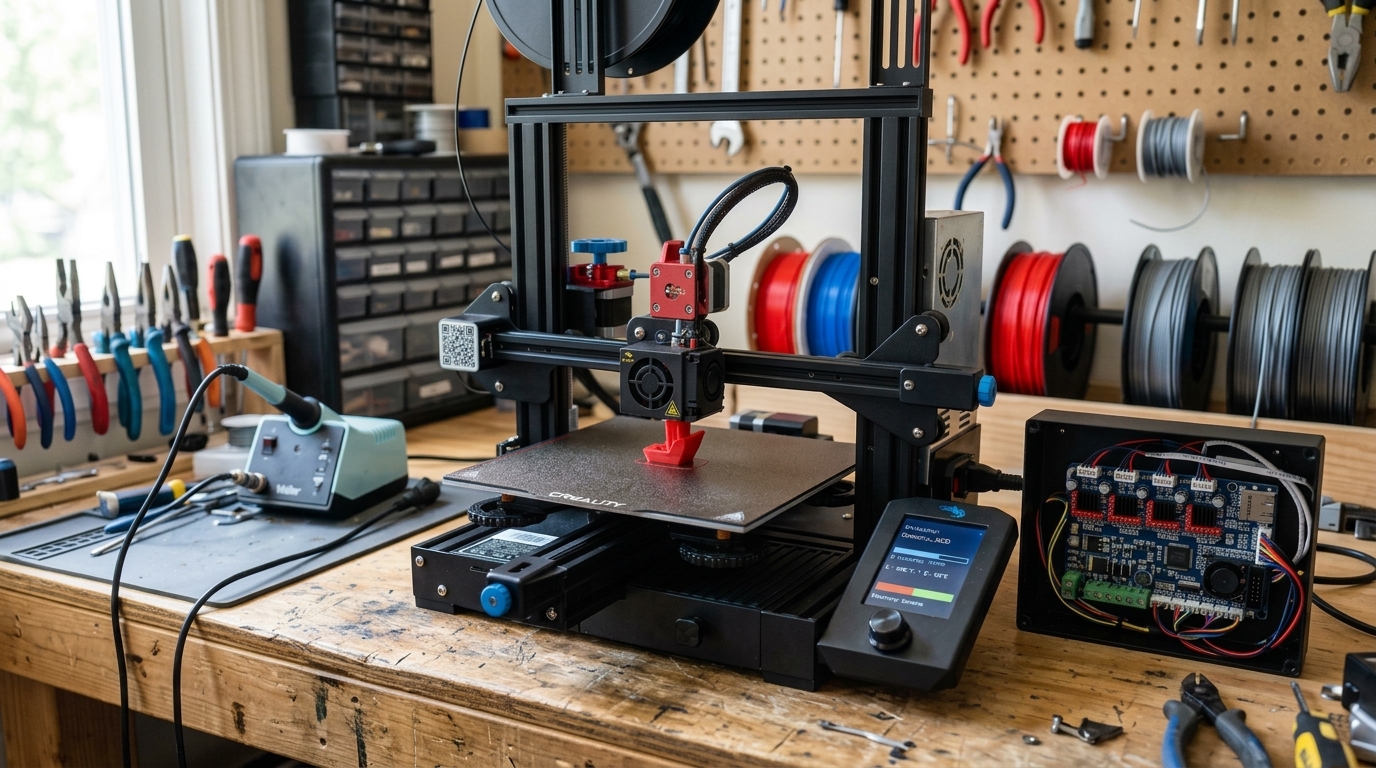
Full Ender 3 V2 Build: Micro Swiss Dual-Gear Direct Drive Extruder, Ender 3 V2 Color LCD Screen, and BigTreeTech SKR Mini E3 V3.0 Motherboard Mounted Inside Side Box
Stock Creality vs. Customized High-End Specification Matrix
⚡ 2. Why These 4 Core Upgrades Produce High-End Print Results
A. Micro Swiss Dual-Gear Direct Drive: Eliminating Stringing & Enabling Flexible TPU
In Bowden extrusion setups, filament must travel through a 400mm PTFE tube. This introduces 4.5mm to 6.0mm of retraction distance and significant hysteresis. By mounting the Micro Swiss CNC Dual-Gear Direct Drive assembly directly above the heatbreak, retraction is reduced to just 0.6mm to 0.8mm at 45mm/s. This completely eliminates stringing and allows printing flexible TPU 95A/85A filaments at crisp speeds without jamming!
B. PT1000 RTD Sensor & 70W Ceramic Cartridge: Printing Engineering ASA & ABS
Standard NTC 100k thermistors lose accuracy rapidly above 240°C. The platinum-element PT1000 RTD sensor maintains ±0.15°C linearity up to 500°C. Paired with a 70W high-power ceramic heating cartridge, thermal melt zone recovery is instantaneous during high-volumetric extrusion (22 mm³/s melt rates). High-temperature engineering plastics like ABS, ASA, and Polycarbonate print with flawless inter-layer adhesion without thermal sagging.
C. BTT SKR Mini E3 V3.0 (TMC2209 UART): Silent Movement & Resonance Compensation
The BTT SKR Mini E3 V3.0 replaces noisy A4988/TMC2208 drivers with onboard TMC2209 stepper drivers in software UART mode. This enables dynamic motor current configuration (`run_current: 0.650A`), StealthChop silent motion, and SpreadCycle torque mode for high-speed travel moves (250 mm/s travel speeds). When running Klipper Input Shaping (MZV / EI shaper), resonance vibrations are neutralized, producing silky-smooth, ringing-free vertical walls!
📄 3. Klipper & Marlin Configuration Snippets
Klipper Printer.cfg Code for PT1000 & Micro Swiss Direct Drive:
# Klipper Configuration for Customized Ender 3 V2 (BTT SKR Mini E3 V3.0)

[extruder]
step_pin: PB3
dir_pin: !PB4
enable_pin: !PD1
microsteps: 16
rotation_distance: 24.85 # Calibrated for Micro Swiss Dual-Gear Extruder
nozzle_diameter: 0.400
filament_diameter: 1.750
heater_pin: PC8
sensor_type: PT1000 # High-temperature Platinum RTD Sensor
sensor_pin: PA0
control: pid
pid_Kp: 22.42
pid_Ki: 1.30
pid_Kd: 96.50
min_temp: 0
max_temp: 350
max_extrude_only_distance: 100.0
pressure_advance: 0.035 # Direct Drive tuned pressure advance

[tmc2209 extruder]
uart_pin: PC11
tx_pin: PC10
uart_address: 3
run_current: 0.650
stealthchop_threshold: 0

[input_shaper]
shaper_type_x: mzv
shaper_freq_x: 54.2
shaper_type_y: ei
shaper_freq_y: 41.8
🔌 4. SWD Hardware Recovery & Unbricking Architecture
If an interrupted firmware flash bricks the microcontroller, you do not need to discard the motherboard. The BTT SKR Mini E3 V3.0 features a dedicated 5-pin SWD debug header (`SWDIO`, `SWCLK`, `NRST`, `GND`, `3.3V`). By wiring a Raspberry Pi GPIO bitbang interface or an ESP32 wireless bridge, you can execute raw OpenOCD chip erase commands and re-flash the factory bootloader over SWD in less than 30 seconds!
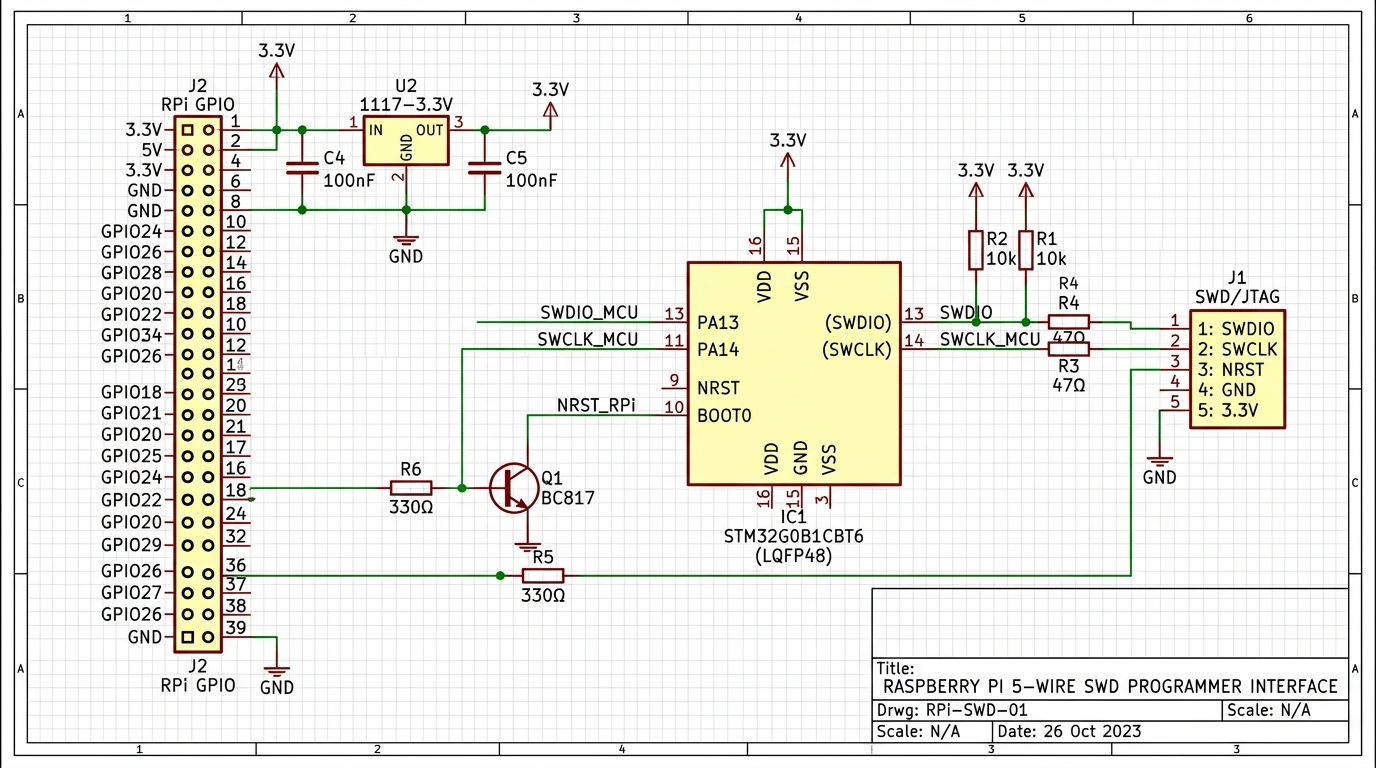
KiCAD EDA Circuit Schematic: 5-Wire SWD Debugger and OpenOCD Hardware Connection Diagram
🏆 Summary & Print Benchmarks
By executing these 4 strategic hardware upgrades, a standard Ender 3 V2 morphs into a professional-grade additive manufacturing tool. Benchmarks demonstrate **±0.03mm dimensional accuracy across 100mm test cubes**, zero stringing on complex TPU prints, and rock-solid 300°C thermal stability for structural ASA components!